
The mock exam mistake that costs students a full grade
The mock exam mistake that costs students a full grade
 Faisal Shamim
Most students walk into their mocks having revised the wrong thing. Not the wrong topics. The wrong skill. And it quietly costs them a grade before they have written a single word.
Every winter we see the same pattern. A hardworking Year 11 or Year 13 student spends weeks making beautiful notes, highlighting textbooks and rereading class work. They feel ready. Then the mock results arrive and the grade is lower than everyone expected, including the student. Parents are confused, the student is deflated, and the usual conclusion is “they need to work harder”.
In our experience, effort is rarely the problem. The problem is that they prepared to know the content, but the exam rewards the ability to use it, under time pressure, in the exact way the mark scheme wants. Those are two different skills, and only one of them is being practised.
The mistake: revising like a reader, not like an examinee
Rereading notes feels productive. The material looks familiar, so the brain says “I know this”. But recognising something on a page is not the same as recalling it from a blank sheet, and it is nothing like applying it to an unfamiliar question with a clock running.
Mock exams test three things at once:
- Recall: can your child pull the right fact, formula or quotation out of memory without prompts?
- Application: can they use it on a question they have never seen before, worded in a way that is designed to make them think?
- Exam technique: do they know how marks are actually awarded, how long to spend on each question, and what an examiner needs to see written down?
Rereading trains none of these. That is why a student can “know everything” and still drop marks on almost every page.
Why it costs a full grade
On many GCSE and A-Level papers, the gap between one grade and the next is only a handful of marks. Now think about where marks quietly leak away:
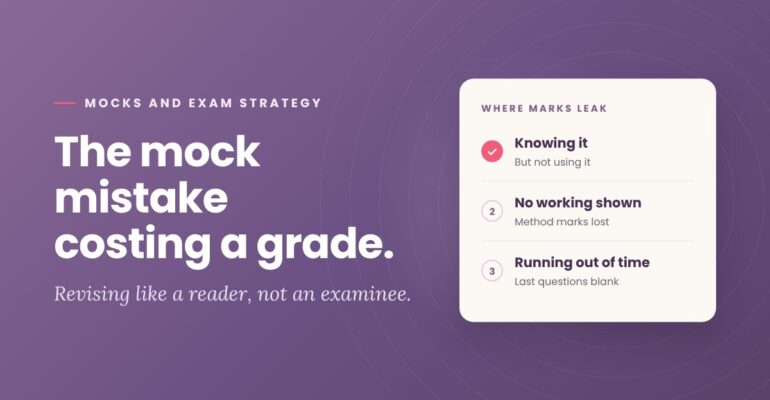
- A correct answer with no working shown in Maths, so the method marks are lost when a small slip happens.
- An English Literature paragraph that retells the plot instead of analysing the writer’s choices.
- A Science six-mark question answered with three good points, when the mark scheme needed a linked explanation.
- Running out of time and leaving the last, high-value question half finished.
Two or three marks here, two or three marks there. None of these are knowledge problems. Add them up across a paper and you have the difference between a 5 and a 6, or a B and an A. That is the grade that “hard work” alone does not fix.
What the top students do differently
The students who outperform their predicted grades are not always the ones who revise the longest. They revise in a way that looks a lot more like the exam itself.
1. They test themselves before they feel ready
Instead of rereading a chapter, they close the book and write down everything they remember, then check what they missed. It feels harder, and that is exactly why it works. Effortful recall is what makes knowledge stick and come back on the day.
2. They practise with past papers early, not just at the end
Past papers are not a final check. They are the main training tool. Doing questions topic by topic from November onwards means a student has seen dozens of ways a topic can be asked long before the real exam.
3. They mark their own work with the real mark scheme
This is the step most students skip, and it is the most valuable. Reading the mark scheme shows exactly what earns credit: the key words, the structure, the level of detail. After a few weeks, students start writing for the examiner automatically.
4. They practise under time pressure
Doing a question slowly with notes open is useful at first. But at some point it has to be done in silence, with a timer, at exam pace. Timing is a skill, and like any skill it improves with repetition.
5. They keep a “mistakes list”
Every lost mark goes on a list: what went wrong and what the correct approach is. Before the next paper, they read the list. It is the fastest way to stop losing marks for the same reason twice.
How parents can help this week, without becoming the revision police
You do not need to know the subject to make a real difference. Try these small, calm steps:
- Ask one question at dinner: “What is one thing you could explain to me from today without your notes?” Explaining out loud is retrieval practice in disguise.
- Swap “how long did you revise?” for “how many questions did you do?” It gently shifts the focus from time spent to active practice.
- Find the past papers together. Ask which exam board each subject uses, then look up the board’s past papers and mark schemes. Having them ready removes a common excuse.
- Protect one timed session a week. Phones in another room, a timer on, one section of a paper. Keep it short and regular rather than long and rare.
- Treat the mock as information, not a verdict. A disappointing result in December is a gift if it shows exactly which marks are being lost while there is still time to fix them.
A simple three-week plan before the mocks
If the mocks are about three weeks away, this rhythm works well for most students:
- Week one: find the gaps. One short past paper section per subject, marked honestly with the mark scheme. Every lost mark goes on the mistakes list.
- Week two: fix the gaps. Short, focused sessions on the topics that came up on the list, each finished with a few exam questions on that topic.
- Week three: rehearse. Full or half papers under timed conditions, then a quick read of the mistakes list the night before each exam. No new topics in the final days.
The real purpose of a mock
Mocks are not a prediction carved in stone. They are the most useful diagnostic test your child will sit all year. The students who make the biggest jumps between mocks and the real exams are the ones who look closely at where the marks went, and change how they prepare.
That is also where many families struggle. Teachers are stretched across whole classes, and a mock paper often comes back with a grade and a few comments, but not a clear plan. Students know they did not do as well as they hoped. They just do not know precisely why, or what to do differently on Monday morning.
Where SmartEdge comes in
At SmartEdge, our tutors work one to one with GCSE and A-Level students in Maths, Science and English. We do not simply reteach the syllabus. We look at how your child answers questions, find the specific habits that are costing marks, and build a plan around their exam board, their mark schemes and their timetable.
Every family starts with a free trial lesson. In 30 minutes, your child works with a tutor matched to their subject and level, and you receive honest feedback on where they are and what would help most before the mocks and beyond. There is no obligation and no contract.
If your child’s mocks are coming up, the best time to change how they prepare is now, not after the results arrive.
Prefer to talk first? Message us on WhatsApp on +44 7401 078622 and a member of our team will help you choose the right next step.